

Requirement
High Temperature Soldering
Pick up articles








Table of contents
What is high-melting point solder alloy?
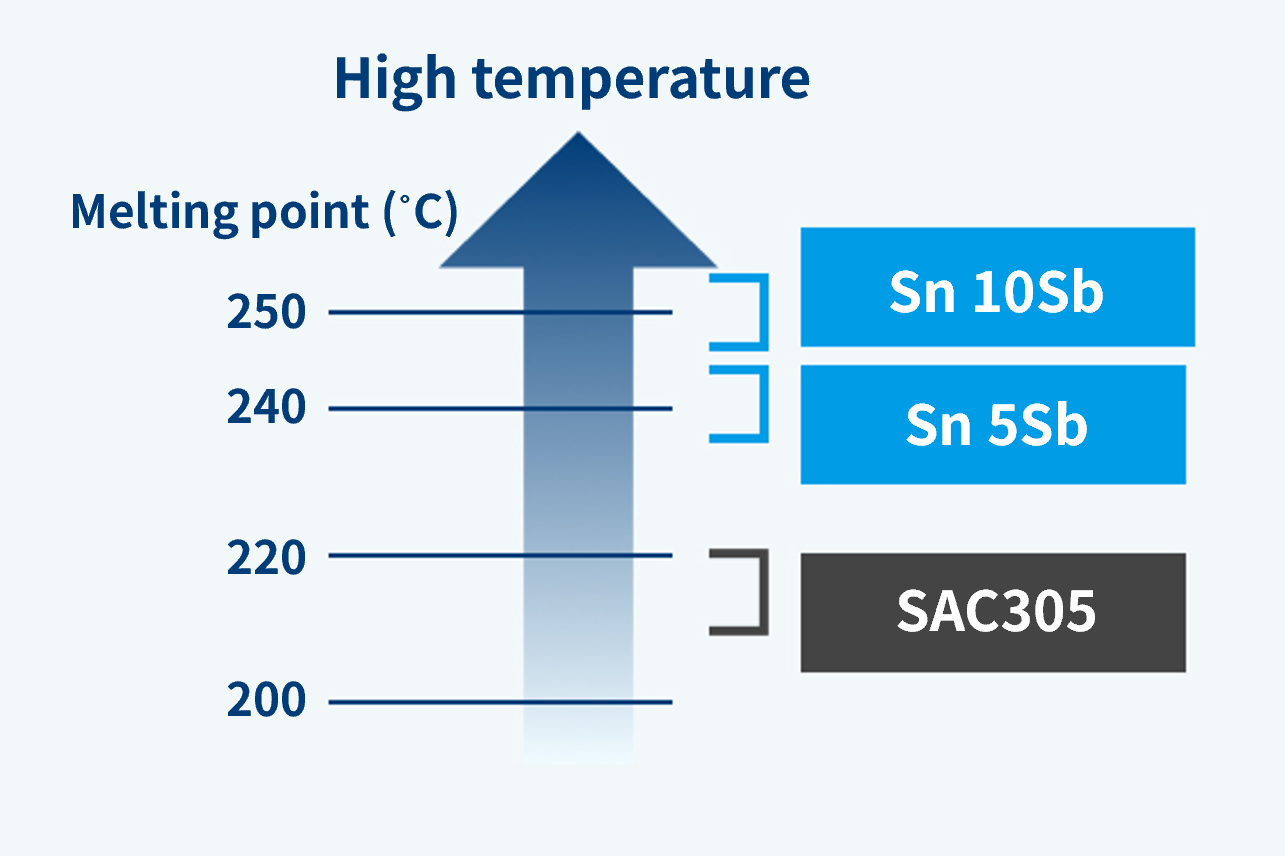
Most popular lead-free solder alloy is SAC305(Sn/3Ag/0.5Cu) and its melting point is 217~219˚C. However, requirements in specification become so versatile that a demand for high melting point solder is increasing. Most of high-melting point solder alloy’s composition is Sn/Sb base.
e.g.
・Sn/5Sb 238~241℃
・Sn/10Sb 242 ~256℃
Market demand
Traditionally, the leaded alloy Sn5/95Pb (with a melting point of 300–314°C) has been the most widely used high-melting-point solder. Driven by biological and environmental concerns, lead-free solder technology has advanced significantly, leading to an increasing demand for lead-free high-melting-point solder compositions.
Example of lead-free high melting point solder alloy application
Preventing Re-melting and Component Drop-off in Double-sided Reflow
In double-sided PCB assembly using conventional SAC305 solder paste (which requires a peak reflow temperature of 240–250°C), solder joints formed during the first reflow process can re-melt during the second reflow, potentially causing components to fall off.
To mitigate this risk, a Sn/Sb-based solder paste can be applied in the first reflow, followed by SAC305 in the second reflow. The distinct difference in their melting points ensures that the first-side Sn/Sb joints remain intact and do not re-melt, thereby preventing component drop-off.
Consequently, module manufacturers are increasingly adopting high-melting-point solder alloys for embedded passives to ensure that their products can withstand subsequent re-reflow processes at end-customer facilities.
Increasing junction temperature
Junction temperature requirement is ever-increasing. Sometimes melting point as high as SAC305 is not sufficient. By using Sn/Sb- type solder alloy, operation under high-temperature environment can be ensured.


Contact Us Inquiry
For any requests for estimates, product information, technical questions, etc. please reach out to us.